Ellie in your candle workspace
What Ellie can do when your active craft is candle — the candle pantry tools, starting a recipe, and the candle knowledge she brings to the conversation.

Ellie follows your active craft. When Candle is the craft you're in, the assistant knows the candle pantry, speaks candle, and has tools built for wax, wicks, fragrances, and vessels.
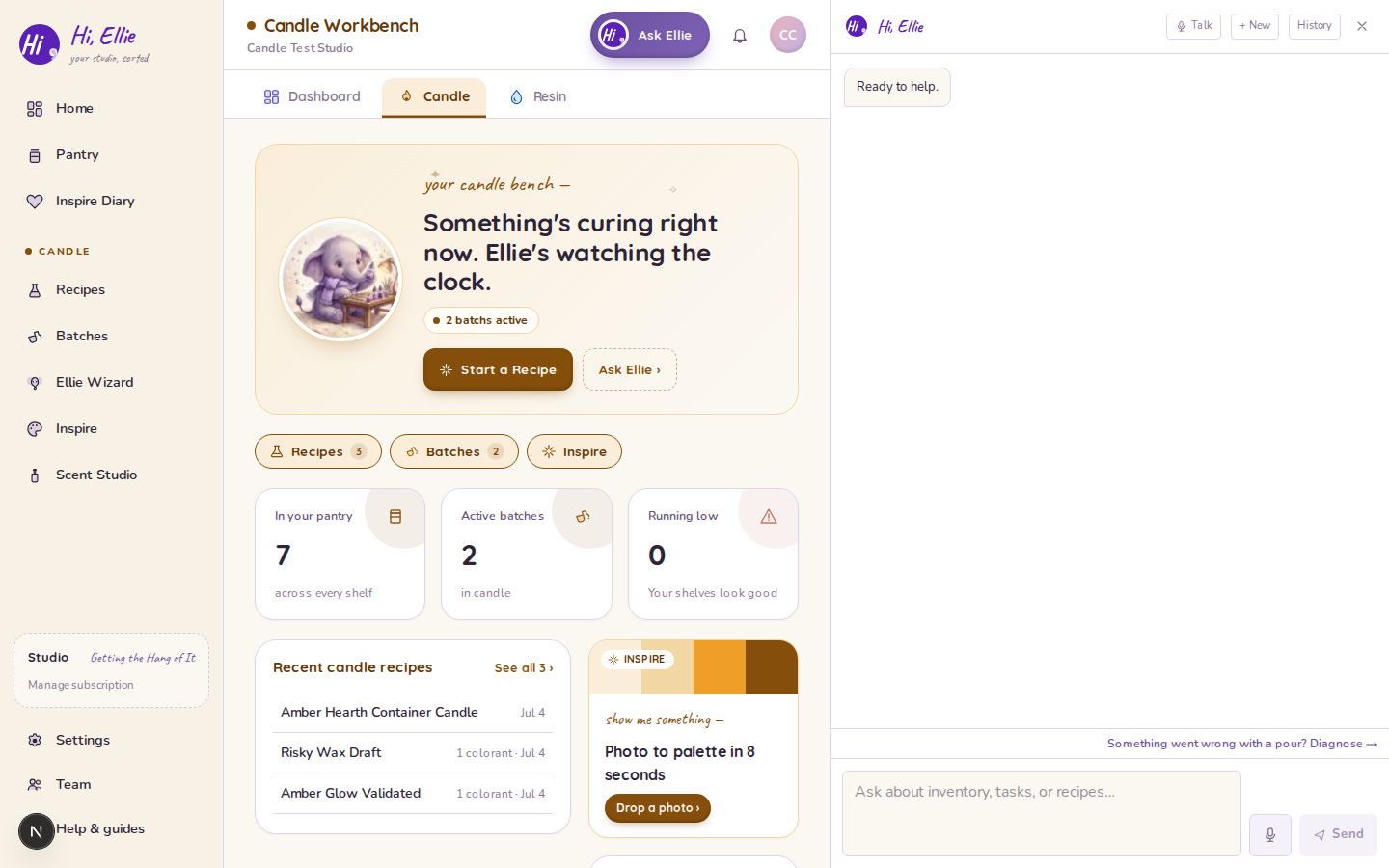
Reach her the same two ways as always: the Ask Ellie pill (bottom-right on desktop) or the center dome on mobile opens the assistant chat, and the Ellie Wizard builds recipes. See the two ways to reach Ellie if that distinction is new.
Managing your candle pantry from chat
In a candle workspace, Ellie can read and update your candle shelves directly — no need to leave the conversation:
- "Add CandleScience Golden Soy 464 to my pantry."
- "I'm down to two pounds of coconut wax."
- "What wicks do I have for a three-inch jar?"
- "Add a new fragrance — Amber Noir, flash point 185."
She works the Waxes, Wicks, Fragrance Oils, and Vessels shelves the same way she works the resin pantry. If you describe a wick that isn't in our catalog, she can propose a custom size and bind burn guidance to it rather than saving it as a mystery.
Starting a recipe
Ask Ellie to make something and she hands off to the candle wizard with your idea pre-filled:
- "Make me a warm amber candle for an 8-ounce tumbler."
Ellie doesn't generate the recipe inside the chat — the wizard owns the wax, fragrance-load, and wick math, so you land there ready to go. She'll first check that you have at least one wax and one fragrance; if not, she'll tell you what to add.
Candle know-how
Ellie brings real candle knowledge to the conversation, and she'll reach for it when you ask:
- "Why is my candle tunneling?"
- "How long should soy cure before I sell it?"
- "What fragrance load is safe for this wax?"
- "My wick is mushrooming — what should I change?"
A few rules she holds to, because they matter: fragrance load is a percentage of the wax weight and stays within the supplier's max (IFRA Category 12); your wax row sets the add and pour temperatures, not the fragrance flash point — the flash point is printed as a fact beside the fire-safety step, which is where it belongs (no flame or bare element near the pot); gel takes only oils with a flash point of 170°F or higher, a rule about which oil goes in rather than how hot you pour; and she'll always remind you to trim the wick to 1/4 inch.
The first burn reaches a full melt pool rule is one she scopes rather than repeats at everything. It belongs to a candle burning in a vessel, where the vessel is what holds the melt. A free-standing pillar she coaches the other way — put the candle out before the pool reaches the outside, because its own outer wall is the only thing holding the melt in. And for a candle released from a mold she gives no wick verdict at all: see Logging a burn test for which candles get one.
Heads up: Ellie is a knowledgeable studio partner, not a safety authority. For anything you sell, confirm your fragrance loads against your supplier's documentation and follow candle fire-safety labeling (ASTM F2058) yourself.