Making a candle recipe with Ellie
How the candle wizard builds a recipe from your pantry — the wax, the fragrance blend and load, the wick recommendation, and the safety checks Ellie runs for you.

The candle wizard is where Ellie turns an idea into a buildable candle recipe: a wax, a fragrance blend, a load percentage, a wick, and pour temperatures — all grounded in what's on your shelf.
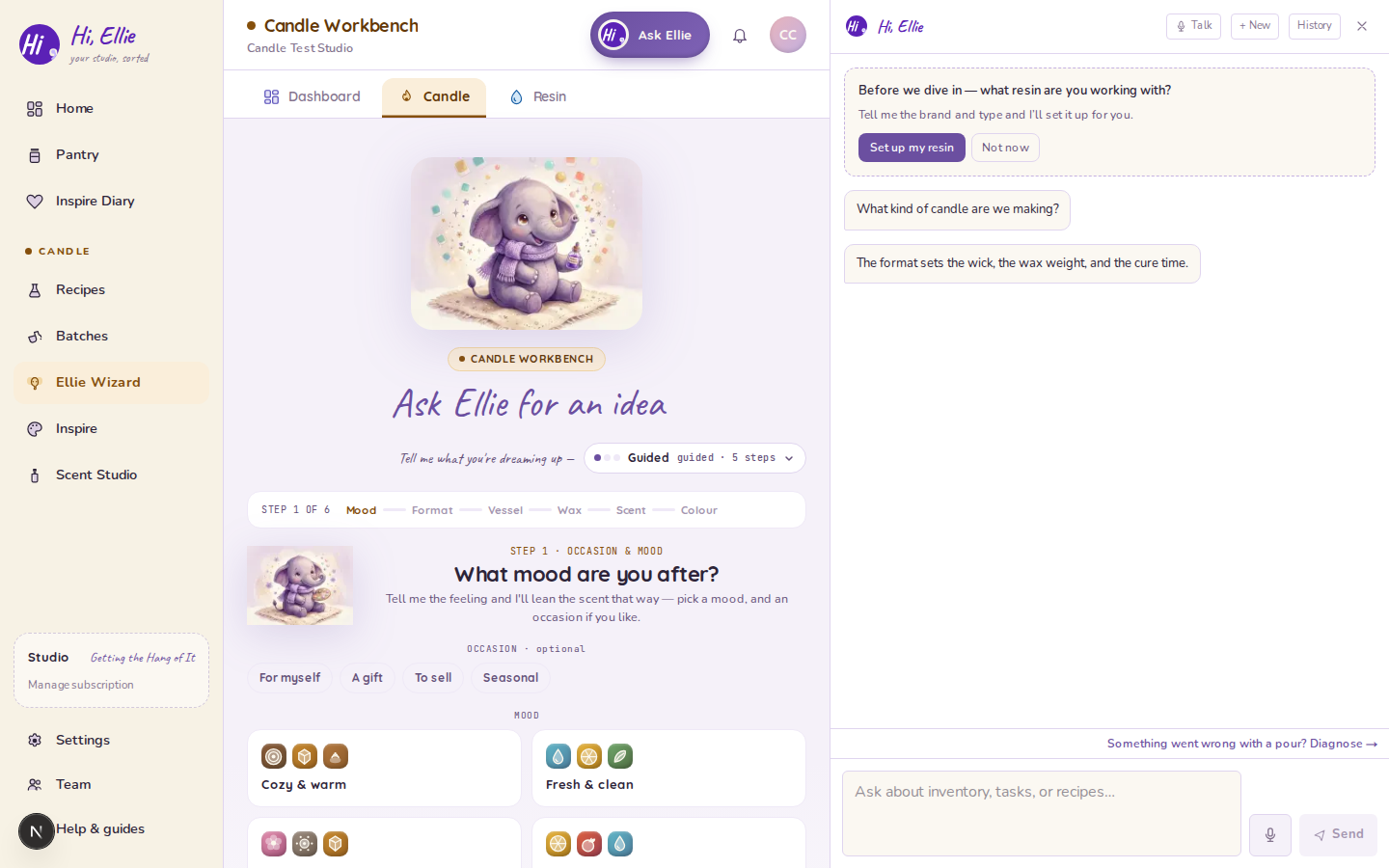
Open it from Ellie Wizard in your candle workspace's menu (or the /ellie route while Candle is active). If your pantry has no wax or no fragrance yet, the wizard will point you to the pantry first — Ellie can't build a candle out of an empty shelf.
Pick how hands-on Ellie is
Like the resin wizard, the candle wizard has three modes, and you can switch between them anytime:
- Guided — Ellie makes the calls and explains as she goes. Best when you're new to a wax or a vessel.
- Collab — a back-and-forth. You steer the fragrance blend and vessel; Ellie fills in the rest.
- Advisor — you set the specifics and Ellie sanity-checks them and hands you her take.
See Wizard modes: Guided, Collab, and Advisor for how the three compare — the idea is the same across crafts.
What Ellie builds
Describe your candle — a scent direction, a vessel, an occasion — and Ellie proposes:
- A wax from your pantry, with a pour and add temperature.
- A fragrance blend — one oil or a few, each as a percentage of the whole scent.
- A load percentage — the total fragrance as a share of the wax weight, kept within your fragrance's supplier max.
- A wick recommendation — sized to your vessel's diameter, preferring a wick you already stock, and flagging when a size-up is worth testing.
- A colorant, if you dye, limited to candle-safe dyes.
- Steps — melt, add fragrance at temperature, pour, cure.
You can refine any of it in plain language — "make it a stronger throw," "use the coconut wax instead," "drop the dye" — and Ellie re-works the recipe around your change.
The safety checks Ellie runs
A few things Ellie decides in the numbers, not by guesswork:
- Temperatures come from your wax row, not from the fragrance. The fragrance's flash point is printed beside the fire-safety step as a fact about your bench — where the recipe heats the wax to or past it, the step asks for the no-flame rule (nothing burning under the pot, a double boiler or a thermostatic melter, and don't leave it). No recipe is refused over a flash point.
- Gel takes only oils with a flash point of 170°F or higher (and non-polar). That is a rule about which oil goes in a gel candle, not about how hot you pour it — gel is poured hot by design — so a gel recipe under that floor gets an advisory that names the oils on your own shelf whose flash point is at or above that floor, never a refusal.
- Fragrance load stays within the supplier max for the oils in the blend (the IFRA Category 12 ceiling).
- The wick is matched to the vessel diameter, not just picked from a list.
Heads up: Ellie's recipe is a strong, safe starting point — but the wick is always confirmed at the bench. Every wax, fragrance, and vessel combination burns a little differently, so plan to burn test and adjust.
Saving and making
Save the recipe to your candle library, then start a batch when you're ready to pour. Ellie logs the batch and, once it's cured and you've burned it, you can record a burn test so the recipe gets better every round.