Logging a burn test
How to record a burn test, what each measurement means, how Ellie reads your notes to tell you whether the wick passed or needs sizing up or down, and which candle formats get a verdict at all.

A burn test is how you find out whether a candle actually works — the right wick reaches a full melt pool, throws its scent, and burns clean. Hi Ellie gives you a place to record each burn and turns your notes into a clear verdict on the wick.
That verdict is for a candle that burns inside a vessel — a container or gel candle, or a votive or tealight poured into a jar. Its criteria are built around a melt pool spreading to a vessel wall, so a piece released from a mold and a wax melt work differently. Which formats get a verdict, below, says how.
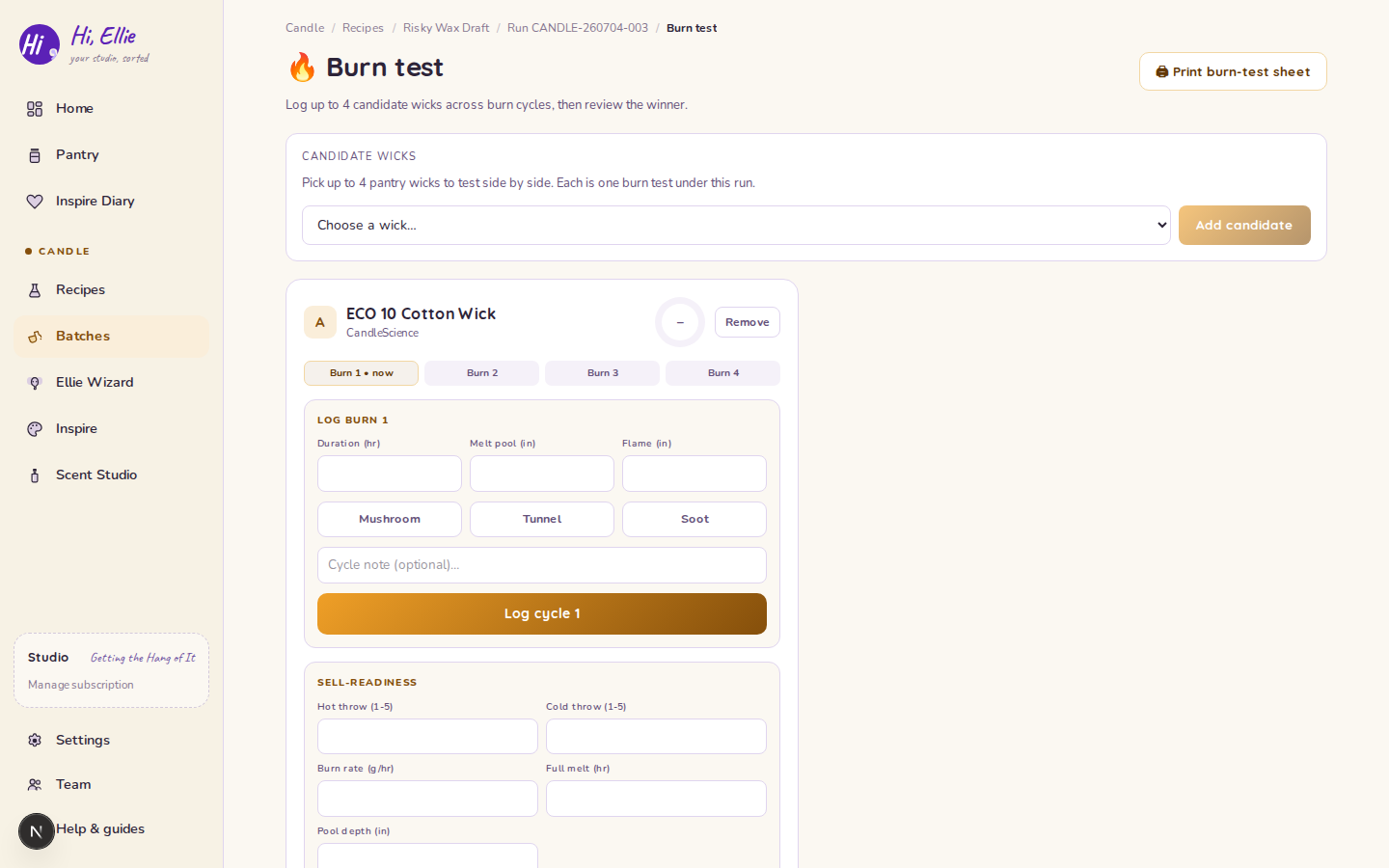
You reach the burn test from a completed candle batch — once a batch is finished, open it and choose Burn test. Cure the candle first: a fresh soy or coconut candle almost always smells weak, so give it one to two weeks before you judge it.
Pick the wick candidates
Start by choosing which wick (or wicks) you're testing. Because dialing in a candle is a process of sizing up or down, you'll often test two side by side. Only wicks in your pantry appear here, so keep a couple of sizes on the shelf.
Record each burn
Light the candle and, for each burn session, record what you see:
- Burn duration — how long it burned this session.
- Melt pool diameter — how wide the pool reached, at the wall.
- Flame height — a rough measure of how the flame is behaving.
- Mushrooming, tunneling, soot — the three warning signs, noted as you see them.
The guide to aim for in a vessel: a candle should reach a full, even melt pool — all the way to the glass — on the first burn, roughly one hour per inch of vessel diameter. A partial first burn is what starts tunneling, and it compounds on every burn after.
A free-standing pillar is the opposite, and the difference matters: its own outer wall of firm wax is the only thing holding the melt pool in, so put the candle out before the pool reaches the outer wall, leaving about 1/4 inch of firm wax standing all the way round. Breach that wall and molten wax runs down the side of a lit candle. Never burn a pillar edge to edge.
The session read
Alongside the per-burn notes, record the overall read:
- Hot throw — how strongly it scents the room while lit.
- Cold throw — how it smells unlit.
- Burn rate — grams of wax consumed per hour (weigh before and after).
- Full-melt time and melt-pool depth — how long to a full pool, and how deep.
Your verdict, and Ellie's
Two judgments live side by side, and they're deliberately separate:
- Your outcome — Pass, Needs adjustment, or Fail — is what you concluded at the bench.
- Ellie's recommendation — passed, size up, size down, or change series — is worked out from the numbers you recorded (melt pool, mushrooming, tunneling, soot), not guessed. Tap "Ellie, what does this say?" to get it.
The two usually agree; when they don't, trust your eyes on the candle and treat Ellie's read as a second opinion grounded in the measurements.
Tip: trim the wick to about 1/4 inch before every burn — a long or curled wick will mushroom and soot no matter how well-sized it is, and it'll skew the test.
Which formats get a verdict
Ellie's recommendation is a vessel read — its criteria are built around a melt pool spreading to a vessel wall — so it isn't offered for every format.
- Burning in a vessel — a container or gel candle, or a votive or tealight poured into a jar — gets the full read above.
- Released from a mold — a pillar, or a votive or tealight unmolded — gets no recommendation. Hi Ellie has no pass/fail criteria for that burn: how a piece released from a mold burns has not been worked out here, so nothing here judges it in either direction. Log it anyway: it's your own record of how that wick behaved, and it's kept as an observation rather than scored.
- A wax melt is warmed on a warmer rather than burned. It has no wick and no flame, so there's no burn test to run for it at all.
You can start a test batch and record burns for any of them — what changes is whether a verdict comes back at the end.
Print a blank sheet
If you'd rather record at the bench on paper, use Print sheet to get a blank recording sheet for the batch, then enter the numbers afterward.
Once a wick passes, mark it as the recipe's wick so the next batch starts from what worked.