From-scratch soap: Cold Process, Hot Process and Liquid
The three lye methods — what you pick, what Hi Ellie computes for you, the goal presets and superfat, and the water convention each alkali uses.

From-scratch soap is the one Bath & Body path that makes soap out of raw ingredients: you mix your own lye solution and saponify your own oils. Read Working safely with lye before your first batch — this article is about the recipe, that one is about not getting hurt.
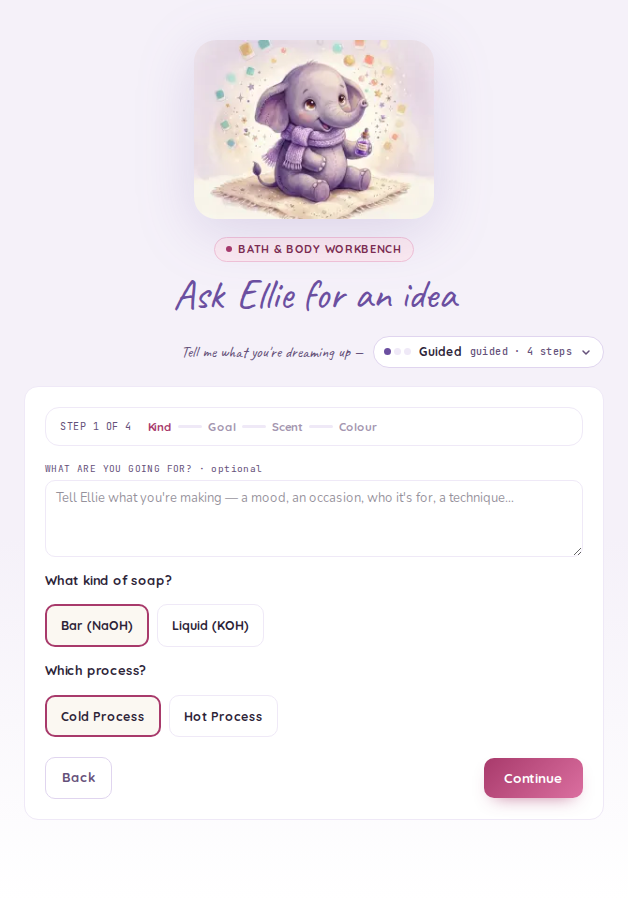
Two picks that decide everything else
The first card asks two questions:
- What kind of soap? — Bar (NaOH) or Liquid (KOH). Sodium hydroxide makes a hard bar; potassium hydroxide makes liquid and soft soap.
- Which process? — Cold Process or Hot Process. (A Liquid recipe skips this — liquid soap is cooked by definition.)
Together those give you the recipe's method: cp, hp, or liquid.
The goal preset
Rather than asking a new maker to author an oil blend, the Guided flow asks what the soap is for, and assembles the blend behind that. The presets are filtered to the alkali you picked, so a Bar maker never sees a liquid preset. Here is the full set:
| Bar (NaOH) | Liquid (KOH) |
|---|---|
| All-Purpose · Moisturizing · Great Lather · Long-Lasting / Hard Bar · Facial / Sensitive Skin · Shampoo Bar · Shaving Soap · Utility / Kitchen | Clear & Mild · Rich Lather Body Wash · Concentrated Dilutable Base |
Guided shows a shorter bar list than that. Two of the eight — Facial / Sensitive Skin and Utility / Kitchen — are held back from the Guided card stack, so a Bar maker there picks from six. Collab's preset menu is filtered by the alkali alone, so all eight bar presets are on the table there. Advisor has no preset picker at all — you author the oil blend line by line and set the superfat yourself. The three liquid presets all show in Guided and Collab.
Each preset carries its own starting superfat — that's much of what separates them. Facial / Sensitive Skin and Shampoo Bar start at a generous 8%; All-Purpose, Moisturizing, Great Lather and Long-Lasting sit at 5%; Shaving Soap, Utility / Kitchen, Clear & Mild and Concentrated Dilutable Base start at 2%, and Rich Lather Body Wash at 1%. In Advisor mode you set the superfat directly and the lye weight recomputes as you type.
What Hi Ellie computes, and what it reads
Nothing about the caustic side of the recipe is written by the model. It is computed in code, from data:
| Number | Where it comes from |
|---|---|
| SAP values | Each oil's NaOH SAP / KOH SAP from the oil catalog — visible on the card for every oil on your Oils & Butters shelf. |
| Lye weight | The oils' weights times their SAP values, reduced by your superfat. |
| Lye purity | The purity recorded on your own pantry row. The field starts empty; when a row records nothing, the app assumes 98% for NaOH and 90% for KOH and says so in as many words beside every weight it prints — "assumed 98% lye purity — none recorded" on a NaOH recipe, "assumed 90% lye purity — none recorded" on a KOH one. |
| Water | The method's own convention, below. |
If you edit the blend or the superfat yourself, those numbers recompute live off your edit — the same code path, not a second one.
Water: two conventions, picked for you
The water your lye dissolves into is not one rule for both alkalis, and Hi Ellie resolves it from the alkali rather than asking:
- Bar (NaOH) — water is 38% of the oil weight, the cold-process convention.
- Liquid (KOH) — a 25% lye solution (three parts water to one part KOH). KOH is more soluble and more exothermic than NaOH, and a liquid soap is cooked to a paste and diluted again afterwards, so the extra water isn't stranded.
Both are documented craft starting points held in code rather than figures read off your records. Neither is a per-recipe field you edit: the water follows the alkali, and the recipe records which convention it used.
Liquid soap has a second water figure. The lye-solution water above is not the dilution water that turns the cooked paste into pourable soap. That one is derived from the paste weight and shown separately on the recipe, with its own note. Because the dilution water is derived from a paste weight that already includes the lye-solution water, changing one moves the other.
Scent, colour and add-ins
The remaining cards are your scent, your colour, and (in Collab and Advisor) your bath ingredients. From-scratch soap's scent ceiling is 6% of the oil weight — see Scenting a Bath & Body recipe.
Cure
Cold-process and hot-process soap needs a cure. Hi Ellie's guidance figure is 28 to 42 days for both: cold process needs the full window to fully saponify and harden, and hot process — usable sooner, since it saponified in the pot — still benefits from a shorter cure. Liquid soap gets at most a short rest — 0–3 days, to fully dilute and cool — not a bar cure. Melt & Pour sits in the same band (0–3 days) for the same reason: the base is already soap, so there is nothing left to saponify, and a M&P bar is usable the day you pour it. Any rest you give it is for firmness and cooling, not cure.
Ellie proposes a cure target for the recipe, and Hi Ellie clamps it into a sane range per method — 14–60 days for cold process, 7–60 for hot process. That clamp is a storage guard, not advice: its low end is not a cure length to aim for.
The recipe's own cure target — not a rule of thumb — is what starts the clock when you complete a batch. See Running a Bath & Body batch.
Before you save
Every from-scratch recipe shows the lye safety acknowledgment with your batch's computed lye and water weights before it will save. Same gate at every experience tier, no bypass. See Working safely with lye.