Reading a Bath & Body recipe: what every section means
A tour of a Bath & Body recipe page — the five numbered sections, and the specs card that changes completely depending on which of the five products you're looking at.

Bath & Body recipe pages share one layout across five very different products, so the page is built as numbered sections with one card that swaps out entirely.
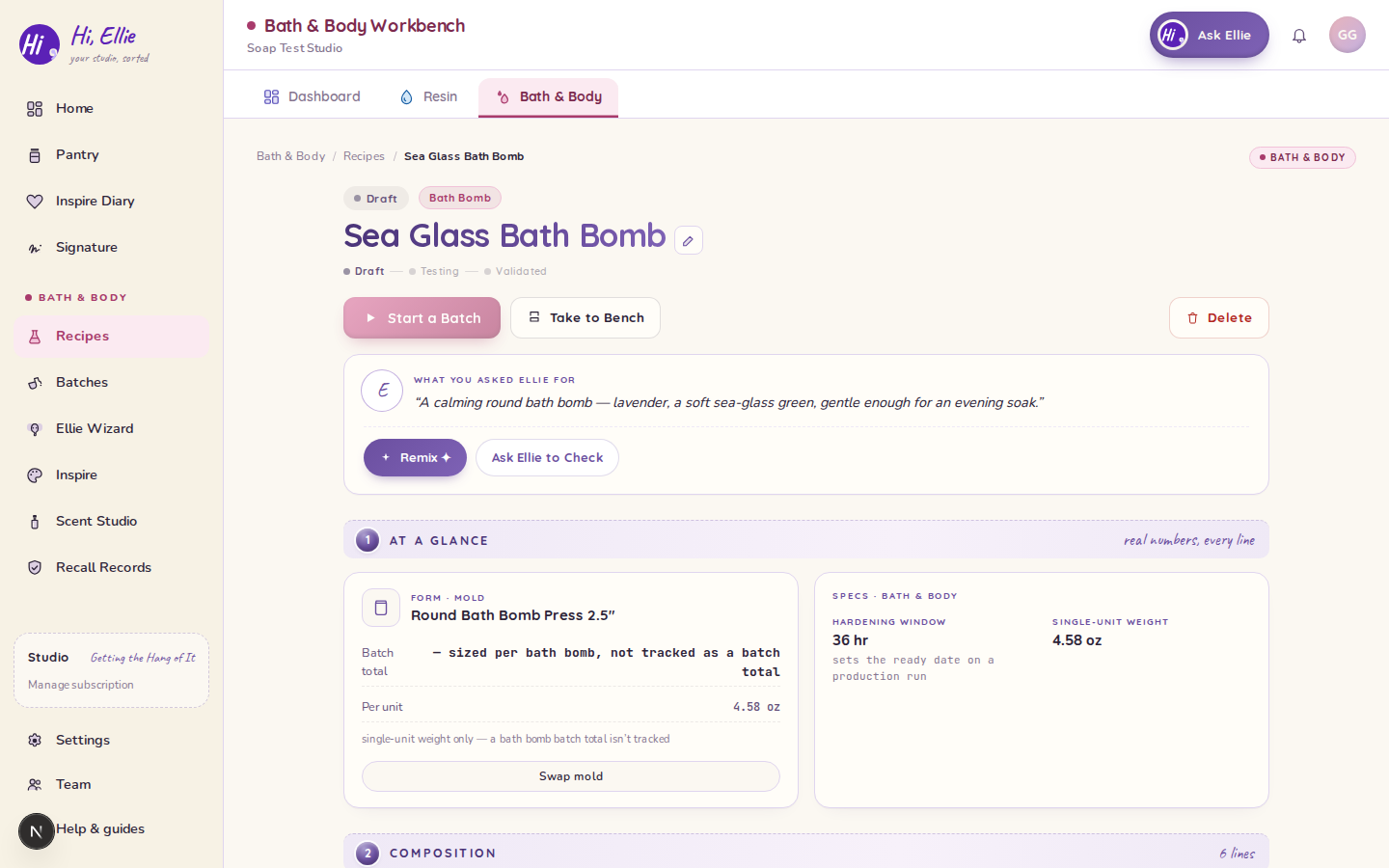
The header
The status pill, the product type, and the recipe name — editable in place if you have edit access. A recipe carries one of four statuses and the pill cycles through them in order: Draft → Testing → Validated → Retired, then back to Draft. Retiring asks you to confirm first, and only a workspace owner can retire a recipe — for anyone else the pill steps straight from Validated back to Draft. Under it, the actions: Start a Batch, Take to Bench (a workbench PDF), and, for owners, Delete.
Below that sits the prompt you gave Ellie, always shown, with Remix ✦ and Ask Ellie to Check for iterating on it.
1 · At a glance
Two cards. The left one is the form — the mold, and how the batch is sized. The right one is Specs · Bath & Body, and it is different for every product:
| Product | What the specs card shows |
|---|---|
| Melt & Pour | The base blend, and each base's share if you blended more than one. |
| Bath bomb | The hardening window (in hours, "sets the ready date on a production run") and the single-unit weight — one bomb's weight, because a bath bomb recipe is one bomb. |
| Scrub | The oil : exfoliant ratio, whether it's emulsified, its preservative (or "Not required (anhydrous)"), and the total batch size. |
| Lotion | The phases (water · oil · cool-down), the emulsifier as a % of batch — noted as included in the oil phase % — the preservative, the target pH, and the minimum preservative weight for the batch. |
| CP / HP / Liquid | NaOH or KOH by weight with its purity basis underneath, the superfat, and the cure in days. |
A figure the page can't stand behind is withheld and explained rather than printed. A scrub whose saved weights no longer recover its stated ratio shows the ratio and an "unverified" note instead of two weights; a lotion whose phases don't total 100 loses its phase weights and gains a line saying why.
2 · Composition
The actual ingredients, grouped by what they are: the oils or the base, the scent lines with their shares, a colorant line, bath ingredients, and then — depending on the product — a Water phase, a Preservative, or a Lye & water ledger card.
A liquid soap recipe also carries a dilution water figure and a loud note about diluting the paste. When one of those figures can't be resolved, the note says which weight is missing rather than going quiet — a missing note and a missing number look identical on a page, and only one of them is something you can fix.
If a row on the recipe doesn't match anything the app recognises, it still renders, labelled as unrecognised with its raw text. Nothing is silently dropped.
Steps — in Ellie's words
The written steps, in the order you'd work them, with amounts scaled to the recipe. Safety copy rides these steps rather than sitting in a banner: the bath-bomb solubiliser amount and its check, the lotion's cool-down and pH steps, and the from-scratch lye handling all appear in the step where you'd act on them.
Notes
Yours to edit inline — what you'd tell yourself next time. It is not only yours, though: this is the same field Hi Ellie folds her own safety paragraphs into when a recipe is saved, so you may find app-written text here alongside your own — a scent usage-limit note, a colorant clarity or acid note, a grounding disclosure, and the What this batch is made of · line — which lists what the save actually bound: your scent, colour, oil shares, base, preservative, everything else weighed into the batch, and on a from-scratch bar the lye and water by name (all the weights stay in the ingredient table). They are written by the app when the recipe is saved, not typed by anyone, and a save that goes back through Ellie rewrites them — so edit around them rather than over them.
Batches
Every production run of this recipe, with its lot code, date and status. Tap a row to open the run. See Running a Bath & Body batch.
Deleting the recipe does not delete your batch records. Bath & Body is not candle's history-wiping model: a completed or abandoned run survives the recipe it was made from — it simply stops pointing at one. Hi Ellie also refuses the delete outright while a run against this recipe is still in progress, and only a workspace owner can delete a recipe at all.
Changing what you're reading
Most cards carry their own change control — swap the mold, swap a preservative, remix the formula, resize the batch. Nearly all of them make a new recipe rather than editing this one, which is not what most makers expect; Changing a saved recipe says which is which.